HFM information and reviews
HFM
96%
FXCC information and reviews
FXCC
92%
FxPro information and reviews
FxPro
89%
FBS information and reviews
FBS
88%
XM information and reviews
XM
86%
Exness information and reviews
Exness
86%

What are defensive stocks and why you should consider them?


The market has fallen sharply this year, and investors have seen losses. Question: Can defensive stocks help hedge against risks? What are their advantages? Should I consider buying them? If yes, should I immediately fill my entire portfolio with defensive stocks? Defensive stocks help protect the portfolio from heavy drawdowns. They fall into the category of save-haven assets together with certain currencies and gold.

What are defensive stocks?

In unstable times, investors are in no hurry to part with defensive stocks. Such securities sink less, and some could grow even in a bear market. But there is also a downside. When the economy is developing, the growth potential is much lower. Defensive stocks are securities of stable companies that make a profit regardless of the state of the economy or overall stock market.

As a rule, this is a business related to essential goods and services, which are always in demand. For example, if a person struggles financially, they may give up on their vacation or a new car, but they won’t probably cut down on medical expenses, food, or electricity.

One can’t name particular features to define a defensive stock. There could be many criteria. But, there are some shared features — a huge market cap, regular dividends, and stable fundamentals. Defense companies have stable profits and dividends. Usually, these are companies related to utilities, medicine, and essential goods. Their financial flows do not depend much on the economy. There is a constant demand for their products.
What are defensive stocks and why you should consider them?

Which assets best protect a portfolio from a market crash?

Defensive stocks are less volatile than the general market and fall less during a crisis. On the other hand, low volatility also means low upside potential. Therefore, defensive stocks underperform in a rising market. And if you build a portfolio of defensive stocks only, it will be a more conservative strategy and low profits.

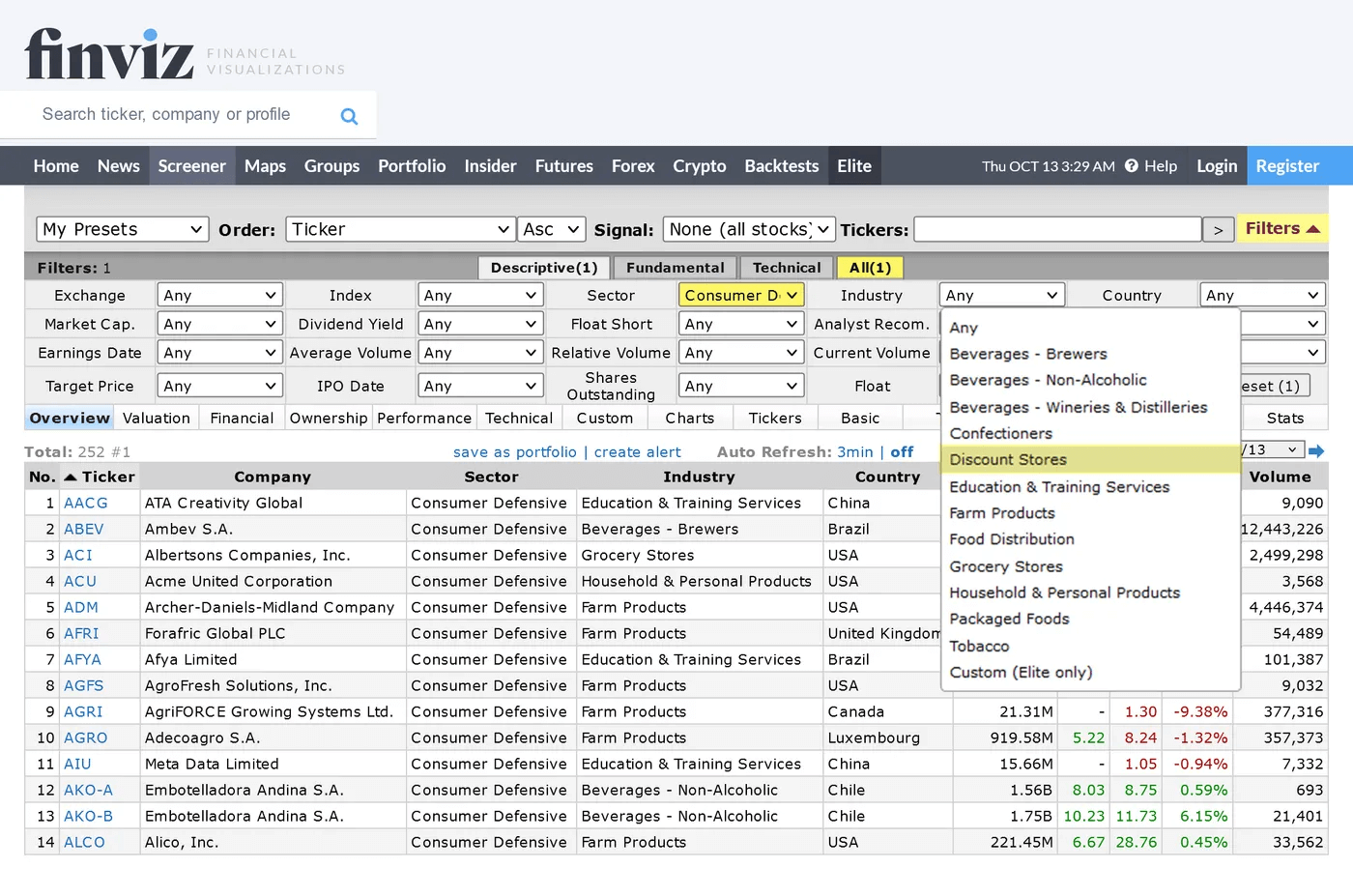
You can use screeners to sort stocks and find defensive ones. In the Finviz screener, for example, you can sort companies by sector and industry. For example, you can select discount stores:

Enjoy trading and earning money on a day-to-day basis!

Open a trading account and trade currency pairs, crypto, stocks, indices, etc. If you’re engaged in day trading, long-term trends don’t influence your trades. You don’t need long-term forecasting and long-term strategies. This goes for currency, stocks, and other assets!

#source


RELATED

Start your Trading with the Right Trading Tools

In this article, we discuss the various trading tools that traders can use to boost their trading, from trading platforms to charting software and trading bots.

Common Trading Mistakes and How to Avoid Them

Have you ever wondered what helped all those professionals of Wall Street become successful? You will be surprised, but the key to their reached heights is hidden in their mistakes...

An overview of platinum trading

When traders log into their metatrader 4 account and consider trading precious metals, it is most likely that the metals of gold and silver first spring to mind...

Beginner’s Guide to Indices Trading

An index tracks the performance of a group of securities or assets, based on predefined characteristics and features. Indices can be organised around industry...

What is a Good Profit Margin in Trading?

Profit margin measures the earnings relative to the revenue. The three main margin metrics are gross profit margin, operating profit margin, and net profit margin...

Get Exposure in Amazon Stock Via CFDs: Insights for Traders

Amazon is unarguably one of the world's most successful companies. Amazon is a marketplace for vendors and buyers of different products from across the globe...

Embarking on ETF Trading: A Beginner's Guide

Entering the world of Exchange Traded Funds (ETFs) trading might appear daunting to newcomers, but it's a surprisingly accessible endeavor, thanks to the abundance of online resources and tools available today...

Understanding the Nuances of Limit Orders in Trading

In the intricate and fluctuating world of trading, limit orders emerge as an essential tool for investors and traders aiming to assert control over their transaction prices...

What is spread in Forex?

Spread is one of the main conditions for trading and investing in Forex. You should know what Forex spread is if you want to trade in the foreign exchange market...

The core concept of money management

Risk management, also known as money management, refers to a number of trading techniques employed to lessen risk exposure. Being affected by various factors...

Black Friday and How it Affects Markets

Black Friday can be best captured by images of customers sleeping in tents outside stores or running in hordes to enter their closest shopping mall, while...

Optimal & Suboptimal Hours in Forex Trading

In the grand tapestry of financial markets, the needle of time weaves intricate patterns. Among traders and investors, the perennial quest to discern the right moments to enter or exit the market resonates deeply...

Trading on Forex - A Primary Source of Income

There are a lot of discussions about trading within the boundlessness of the Internet, both in conventional businesses and state-financed organizations...

How to Calculate Forex Spread

In CFD Trading, the spread is the difference between the "bid" and "ask" price of an asset. In the Forex market, the spread is measured in PIPS. When trading...

How to Build and Diversify Your Ideal Crypto Portfolio

Crypto portfolio allocation is crucial to survival over the longer term. You are betting on the future when trading a cryptocurrency or investing in it. The future is uncertain...

Basic guide to Forex risk management strategies

Trading risk management is vital to becoming a successful trader and making money online. Learn the risks of poor risk management and discover how you could...

A Guide to Trading EURUSD

EUR/USD is the currency pair which matches the exchange rate of euro (EUR) against the US dollar (USD). Traders can trade EUR/USD using financial derivatives like contract-for-differences (CFDs)...

Eight Expert Forex Trading Tips to Maximize Your Success

Forex trading is a thrilling but challenging endeavor. While it offers the potential for significant financial gains, the volatile nature of the markets can also lead to substantial losses...

Everything You Need to Know About Margin Trading

Margin trading is a popular method used by traders all over the world. It can offer attractive opportunities, but as with any form of trading there are no guarantees and the level of risk must be taken...

Insider Trading: What It Is, What It Isn't and Is It Worth It?

The term "insider trading" has been popping up in the headlines recently. There's talk of big-name politicians and business tycoons being investigated for it...

FP Markets information and reviews
FP Markets
81%
IronFX information and reviews
IronFX
77%
AMarkets information and reviews
AMarkets
76%
Just2Trade information and reviews
Just2Trade
76%
FXNovus information and reviews
FXNovus
75%
T4Trade information and reviews
T4Trade
75%

© 2006-2025 Forex-Ratings.com

The usage of this website constitutes acceptance of the following legal information.
Any contracts of financial instruments offered to conclude bear high risks and may result in the full loss of the deposited funds. Prior to making transactions one should get acquainted with the risks to which they relate. All the information featured on the website (reviews, brokers' news, comments, analysis, quotes, forecasts or other information materials provided by Forex Ratings, as well as information provided by the partners), including graphical information about the forex companies, brokers and dealing desks, is intended solely for informational purposes, is not a means of advertising them, and doesn't imply direct instructions for investing. Forex Ratings shall not be liable for any loss, including unlimited loss of funds, which may arise directly or indirectly from the usage of this information. The editorial staff of the website does not bear any responsibility whatsoever for the content of the comments or reviews made by the site users about the forex companies. The entire responsibility for the contents rests with the commentators. Reprint of the materials is available only with the permission of the editorial staff.
We use cookies to improve your experience and to make your stay with us more comfortable. By using Forex-Ratings.com website you agree to the cookies policy.