HFM information and reviews
HFM
96%
FxPro information and reviews
FxPro
89%
FXCC information and reviews
FXCC
86%
XM information and reviews
XM
81%
IronFX information and reviews
IronFX
77%
Just2Trade information and reviews
Just2Trade
76%

Relative Strength Index (RSI): Unveiling Price Momentum and Overbought/Oversold Conditions


Alex Kuptsikevich   Written by Alex Kuptsikevich

The Relative Strength Index (RSI) is a momentum oscillator that measures the speed and change of price movements. Developed by J. Welles Wilder, RSI ranges from 0 to 100, providing traders with a numerical value that reflects the strength and potential direction of price trends.

Calculating RSI

RSI is calculated using the following formula:

Where RS (Relative Strength) is the ratio of the average of 'n' days' up closes to the average of 'n' days' down closes. In simpler terms, RS compares the average gains to the average losses over a specific period (often 14 days).
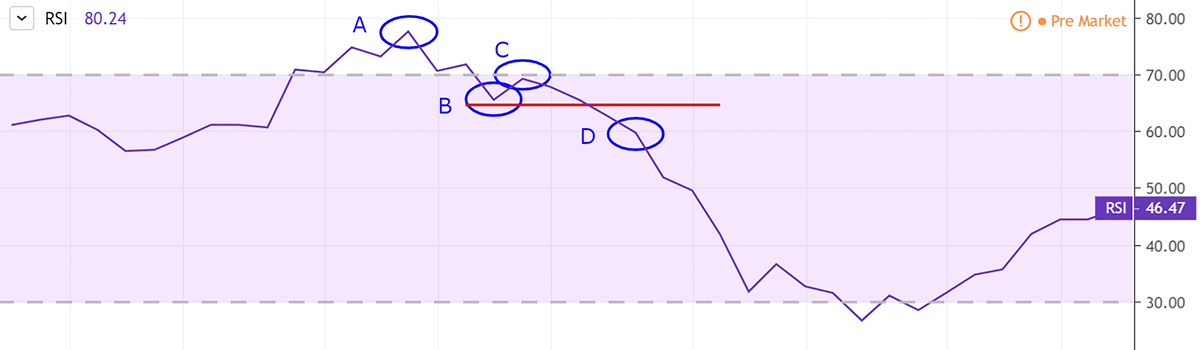
Relative Strength Index (RSI)

Relative Strength Index (RSI)

Interpreting RSI

RSI values are plotted on a scale from 0 to 100. Here's how traders generally interpret RSI:

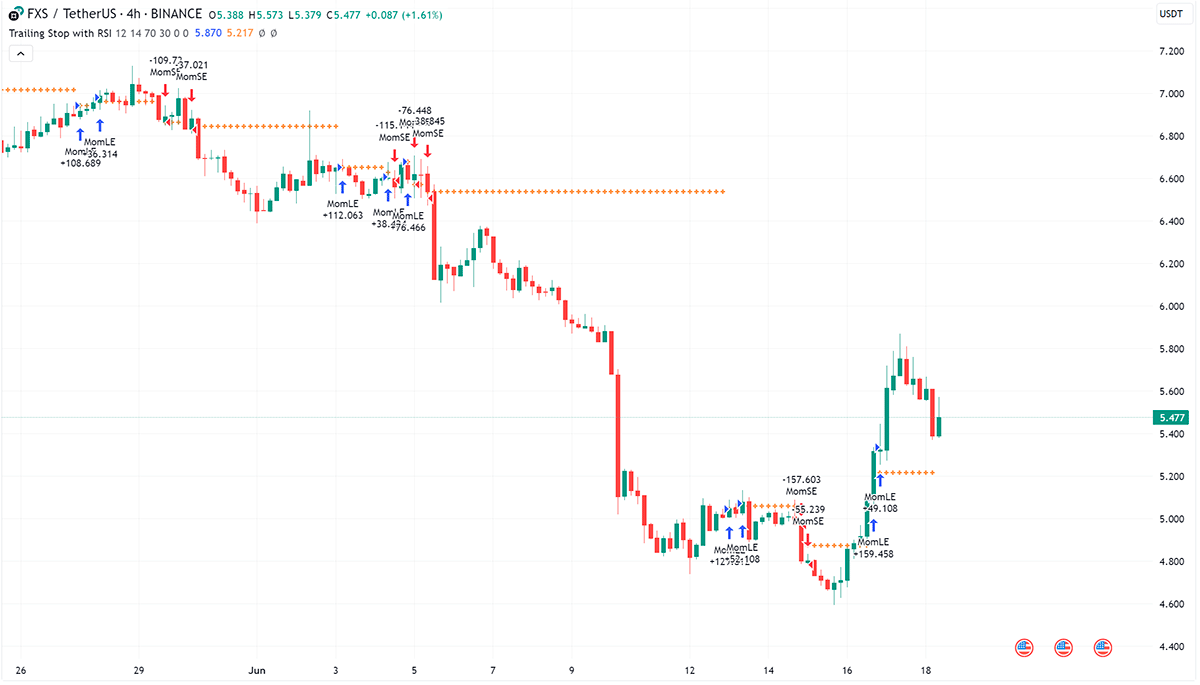
Trailing Stop with RSI - Momentum-Based Strategy

Trailing Stop with RSI - Momentum-Based Strategy

Significance of RSI

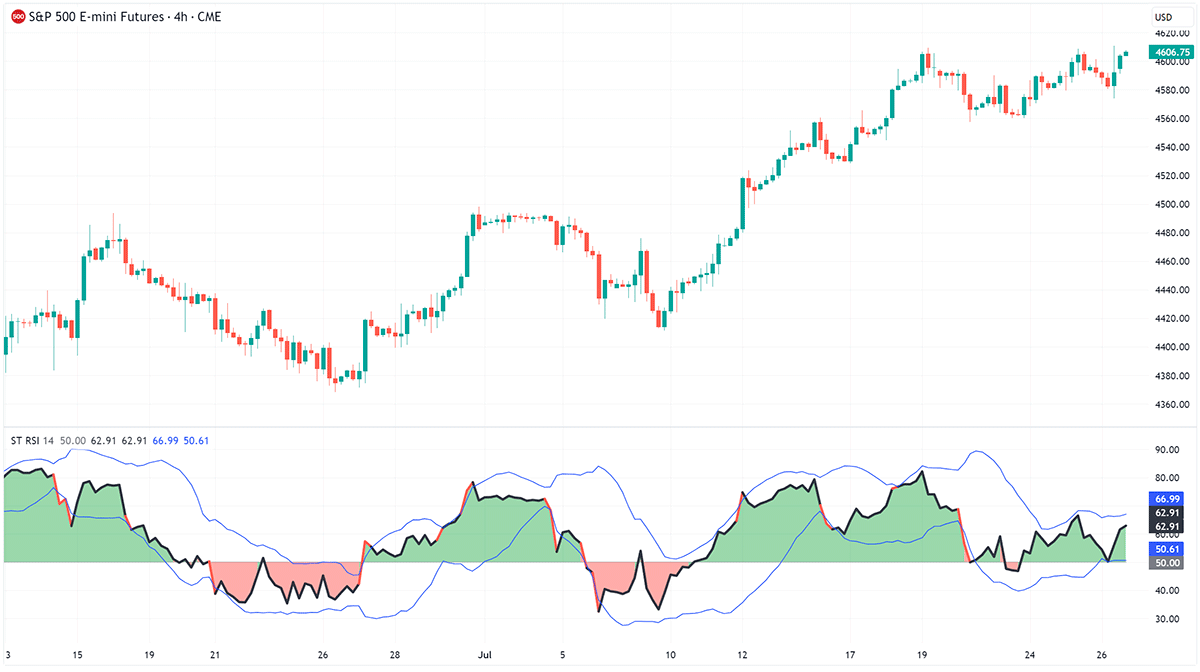
Customized Relative Strength Index (RSI) indicator with added functionality, notably the optional Bollinger Bands overlay

Customized Relative Strength Index (RSI) indicator with added functionality

Conclusion

The Relative Strength Index (RSI) is a powerful tool that aids traders in identifying momentum, overbought, and oversold conditions in the forex market. It empowers traders to make informed decisions based on the speed and magnitude of price movements. As with any technical indicator, it's essential to use RSI in combination with other tools and analysis methods for a comprehensive understanding of market dynamics and trends.

Discover how to interpret forex charts like a seasoned trader. We'll guide you through the anatomy of candlestick patterns, trend lines, and technical indicators that illuminate market trends. Learn how to spot potential breakouts, reversals, and trend continuations using chart patterns. With our expert insights, you'll have the tools you need to navigate the forex market with confidence.


RELATED

What is a central bank?

A central bank is a financial institution that manages the monetary policy and currency supply of a country or group of countries. It is typically responsible for maintaining...

10 Reason to Trade Forex

Foreign exchange, or more colloquially known as forex or FX, is the buying and selling of currencies to make profits based on the changed currencies' values...

Are you looking for a new hobby? Put Your Skills to Better Use

Are you looking for a new hobby, but aren't quite sure where to start? Have you considered you might be a trader? Below are a series of questions that will help...

Introduction To The Emerging Financial Asset Class

Cryptocurrencies are digital currencies built on blockchain technology that exploded in a few years from an industry worth just millions of dollars into a booming...

Black Friday and How it Affects Markets

Black Friday can be best captured by images of customers sleeping in tents outside stores or running in hordes to enter their closest shopping mall, while...

What is Notional Volume and Why Does It Matter

Notional volume is often used as a measurement when valuing a derivative contract. There are also various other ways derivative contracts can be valued...

What is a Bear Market? A Complete Guide

Sometimes, during market cycles, the stock markets may plunge, and prices could fall. It may be for a short period of weeks or months, or even drag on for years...

3 Not-so-hot Tips for New Traders From

A new wave of investors, or collectively known as “Generation Investors”, has spurred into the stock market during the pandemic. Research conducted by the FINRA Investor...

What Is a Stock Index?

A stock index is used to describe the stock market's performance or a specific part of it and compare the returns on investments. In general, an index uses a weighted average of stock prices...

What is Risk Management in Forex?

A trade may be closed profitably or at a loss. Trading, as a whole, may become profitable or lead to losses. Risk management in Forex is about reducing the loss factors.

Choosing a trading instrument: how to trade currency pairs

Early on the path to becoming a trader, every beginner must determine what to trade and how. This choice should be made based on the desired goals...

What is Bitcoin?

Bitcoin is a digital currency that operates without the control of a central bank or the oversight of governments. Instead, bitcoin relies on something called peer-to-peer software...

What Is the OTC Market?

Over-The-Counter markets are popular among investors and traders. This term is mostly associated with the trading of company shares. Yet, it's possible...

Intraday Trading: The Complete Guide

The advent of online trading available to anyone with a smartphone or tablet has opened up financial markets like never before. Modern technology, 24-hour news, and minimum...

What is the financial market?

By definition, the term financial market refers to any marketplace where financial products are traded. These include the stock market, bond market, foreign exchange market...

Becoming a CFD Trader: A Comprehensive Guide

What is a trader? A trader is one of the most used words in the financial vocabulary. It seems straightforward: if you trade an asset, you can be called a trader. Still, not everyone who has ever tried...

Stocks: Top-5 of what you'll want to trade

If you look at the currency charts, they may seem chaotic most of the time. On any timeframe, be it long-term, mid-term, or short-term. The basic reason for that...

Popular trading myths you need to stop believing

If you are a newbie trader and you want to learn the truth about trading, one of the first things you need to have is an accurate understanding of what trading...

A Beginners Guide To Pairs Trading

The ideal strategy is the one that allows a trader to make money in any market, regardless of whether the price is falling or rising. Such trading systems are called arbitrage trading systems...

Short-term trading: Features and Tips

Currency speculations on Forex are short transactions ranging from a few minutes to a month, based on technical and news analysis. In contrast to medium...

T4Trade information and reviews
T4Trade
75%
Riverquode information and reviews
Riverquode
75%
FXCess information and reviews
FXCess
75%
Fintana information and reviews
Fintana
74%
AMarkets information and reviews
AMarkets
0%

© 2006-2026 Forex-Ratings.com

The usage of this website constitutes acceptance of the following legal information.
Any contracts of financial instruments offered to conclude bear high risks and may result in the full loss of the deposited funds. Prior to making transactions one should get acquainted with the risks to which they relate. All the information featured on the website (reviews, brokers' news, comments, analysis, quotes, forecasts or other information materials provided by Forex Ratings, as well as information provided by the partners), including graphical information about the forex companies, brokers and dealing desks, is intended solely for informational purposes, is not a means of advertising them, and doesn't imply direct instructions for investing. Forex Ratings shall not be liable for any loss, including unlimited loss of funds, which may arise directly or indirectly from the usage of this information. The editorial staff of the website does not bear any responsibility whatsoever for the content of the comments or reviews made by the site users about the forex companies. The entire responsibility for the contents rests with the commentators. Reprint of the materials is available only with the permission of the editorial staff.
We use cookies to improve your experience and to make your stay with us more comfortable. By using Forex-Ratings.com website you agree to the cookies policy.