 Written by Feng Zhou
Forex market forecasts are analytical projections of future currency price movements based on observable data, statistical models, and economic reasoning. Their primary purpose is not to predict the market with certainty, but to reduce uncertainty by identifying probabilistic outcomes. In professional trading, forecasts matter because currency prices are influenced by complex and often non-linear interactions between economic, financial, and behavioral factors.
Traders use forecasts to anticipate market movements by forming expectations about direction, volatility, and timing. For example, if a trader forecasts that the euro is likely to appreciate against the US dollar over the next quarter due to diverging interest rate policies, this expectation influences position sizing, entry timing, and risk limits. The forecast does not dictate a trade automatically, but it frames decision-making within a structured hypothesis.
A critical distinction exists between short-term and long-term forecasting in Forex trading. Short-term forecasts may focus on intraday price fluctuations driven by order flow or technical patterns, such as a breakout during the London session. Long-term forecasts, by contrast, often extend over months and rely on macroeconomic trends, such as sustained inflation differentials or long-term capital flows. A trader forecasting a short-term pullback in USD/JPY may hold a position for hours, while a long-term forecast based on monetary tightening could justify holding exposure for several months.
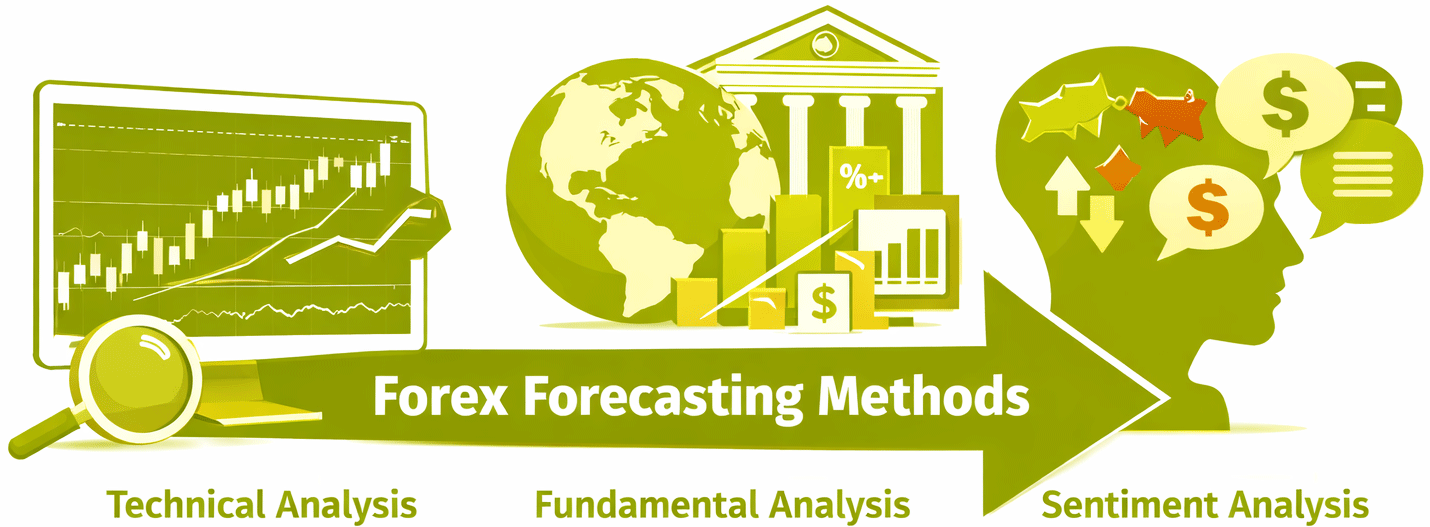
Forex forecasts are constructed using market data that includes historical prices, trading volume proxies, volatility measures, and macroeconomic indicators. Price history plays a central role because financial markets exhibit conditional patterns, such as momentum and mean reversion, that can be statistically observed. For instance, a trader analyzing ten years of EUR/USD data may observe that extended deviations from a long-term moving average often lead to partial corrections rather than immediate trend reversals.
Despite sophisticated models, no Forex forecast is ever 100% accurate. Currency markets are adaptive systems where new information is constantly incorporated into prices. An unexpected policy statement, geopolitical shock, or liquidity disruption can invalidate even the most robust forecast within minutes. For example, a technically sound forecast predicting a gradual appreciation of a currency can fail instantly if a central bank unexpectedly signals policy easing.
As a result, forecasts should be treated as decision-support tools rather than guarantees. Professional traders use forecasts to define scenarios, not certainties. A forecast may suggest that the probability of upward movement is higher than downward movement, but the trader still prepares for adverse outcomes through predefined exit levels. In this sense, the value of a forecast lies not in being right, but in improving the structure and consistency of trading decisions.
Technical analysis relies on the study of price charts, recurring patterns, and mathematical indicators derived from historical data. The underlying assumption is that market prices reflect collective behavior and that this behavior leaves observable traces. A common example is the identification of a bullish trend through a sequence of higher highs and higher lows on a daily chart.
Trend analysis often involves defining support and resistance levels, which represent price zones where buying or selling pressure has historically emerged. For instance, if GBP/USD repeatedly finds support near a specific price level, a trader may forecast that future declines toward that level have a higher probability of stalling or reversing. Indicators such as moving averages can further support this view by showing whether price remains aligned with the prevailing trend.
Common indicators used in Forex forecasting include momentum oscillators and volatility-based tools. A trader might forecast short-term exhaustion in an uptrend if momentum indicators show divergence while price approaches a long-term resistance zone. This forecast does not imply an immediate reversal, but it signals increasing downside risk relative to potential upside.
Fundamental analysis examines economic data and macroeconomic conditions to assess the intrinsic drivers of currency value. Exchange rates are closely linked to interest rate expectations, inflation dynamics, and economic growth differentials. For example, if one economy consistently reports stronger employment growth than another, its currency may attract capital inflows, supporting appreciation over time.
Interest rates play a particularly important role in Forex forecasting. A trader forecasting the future path of a currency often analyzes inflation trends to estimate how central banks might respond. If inflation remains persistently above target, the forecast may assume tighter monetary policy, which can strengthen the currency through higher yield expectations.
Central bank decisions represent a critical focal point of fundamental forecasts. A clear example is a forecast built around anticipated changes in policy language. If a central bank shifts from a neutral stance to a more restrictive tone, traders may forecast a gradual repricing of the currency as markets adjust expectations, even before actual rate changes occur.
Sentiment analysis focuses on the psychological and positioning aspects of the market. Prices are influenced not only by fundamentals, but also by how market participants perceive and react to information. When a large majority of traders are positioned in the same direction, the market becomes vulnerable to sharp reversals.
One way sentiment is analyzed is through positioning data that reflects how different groups of traders are exposed. For example, if speculative traders hold unusually large long positions in a currency, a professional trader may forecast limited upside and increased downside risk, even if fundamentals remain supportive.
News flow and speculation also shape market sentiment. During periods of heightened uncertainty, risk appetite can shift rapidly, causing investors to move away from higher-risk currencies toward perceived safe havens. A trader forecasting during such conditions may place greater emphasis on sentiment indicators than on traditional economic data.
| Aspect | Technical Forecasting | Fundamental Forecasting | Sentiment-Based Forecasting |
|---|---|---|---|
| Primary focus | Price behavior and market structure | Macroeconomic conditions and policy | Trader positioning and psychology |
| Core data used | Historical prices, chart patterns, indicators | Economic indicators, interest rates, inflation | Positioning data, news flow, risk appetite |
| Typical time horizon | Short-term to medium-term | Medium-term to long-term | Short-term to medium-term |
| Reaction to new information | Gradual, pattern-based | Event-driven, often abrupt | Rapid and sometimes extreme |
| Forecast stability | Moderate, depends on market structure | High during stable macro cycles | Low during emotional or speculative phases |
| Example application | Forecasting a pullback within an established trend | Forecasting currency appreciation due to rate hikes | Forecasting reversal due to overcrowded positions |
| Main limitation | Ignores underlying economic drivers | Slow response to sudden market shocks | Highly sensitive to short-term narratives |
Short-term Forex forecasts are typically used by active traders who focus on intraday or multi-day price movements. These forecasts often rely heavily on technical signals and short-term sentiment shifts. For example, a trader may forecast a brief rally following a liquidity sweep during a major trading session, expecting price to revert toward a short-term equilibrium.
Medium- and long-term forecasts are more common among position traders and investors. These forecasts are grounded in macroeconomic trends and structural factors, such as persistent trade imbalances or long-term monetary policy divergence. A trader holding a long-term forecast may tolerate short-term volatility if the broader economic narrative remains intact.
The choice between short-term and long-term forecasting depends largely on trading style, risk tolerance, and time commitment. A day trader benefits from forecasts that emphasize timing and volatility, while a long-term trader relies on forecasts that capture economic cycles and policy trajectories.
| Criteria | Short-Term Forecasts | Long-Term Forecasts |
|---|---|---|
| Typical holding period | Minutes to several days | Weeks to months |
| Main analytical tools | Technical and sentiment analysis | Fundamental and macroeconomic analysis |
| Sensitivity to volatility | High | Moderate |
| Impact of economic releases | Immediate but often short-lived | Structural and long-lasting |
| Risk management approach | Tight stops, frequent adjustments | Wider stops, scenario-based exits |
| Suitable trading style | Day trading, swing trading | Position trading, macro trading |
| Example | Forecasting intraday breakout during a trading session | Forecasting multi-month trend based on policy divergence |
Major currency pairs are the most frequently forecasted instruments due to their high liquidity and economic transparency. These pairs involve currencies from large, developed economies with relatively stable institutional frameworks. As a result, their price behavior tends to reflect macroeconomic fundamentals more consistently.
Major pairs are generally easier to forecast than exotic pairs because they are less prone to sudden liquidity shocks and irregular price gaps. For example, forecasting price behavior in a highly liquid pair during a major economic release allows for more reliable scenario planning than forecasting a thinly traded currency that may react unpredictably.
Volatility and liquidity directly influence forecast reliability. While higher volatility can create opportunity, it also increases forecast uncertainty. Professional traders often prefer instruments where volatility is sufficient to generate returns but not so extreme that it overwhelms analytical models.
| Currency Pair Type | Liquidity Level | Volatility Profile | Forecast Reliability | Typical Forecast Use |
|---|---|---|---|---|
| Major pairs | Very high | Moderate | High | Macro and technical forecasts |
| Minor pairs | Medium | Moderate to high | Medium | Short- to medium-term forecasts |
| Exotic pairs | Low | High and irregular | Low | Opportunistic or event-driven forecasts |
| Safe-haven pairs | High during stress | Spikes during crises | Context-dependent | Risk-off sentiment forecasting |
Economic events are among the most significant sources of forecast deviation. Scheduled data releases can be incorporated into forecasts, but unexpected outcomes or revisions can alter market expectations abruptly. A forecast built on stable growth assumptions may fail if economic data signals a sudden slowdown.
Market volatility and geopolitical risks introduce additional layers of uncertainty. Political instability or international conflict can trigger risk-off behavior that overrides traditional economic relationships. In such cases, forecasts based purely on economic indicators may lose relevance.
Liquidity conditions also affect accuracy, particularly across different trading sessions. Forecasts made during high-liquidity periods tend to be more reliable than those made during thin trading conditions, where price movements can be exaggerated by relatively small orders.
Forex forecasts become effective only when integrated into a broader trading strategy that includes risk management. A forecast suggesting upward movement must be accompanied by a clear assessment of potential downside. For example, a trader may forecast a bullish move but define a maximum acceptable loss if the market invalidates the scenario.
Stop-loss and take-profit levels translate forecasts into measurable outcomes. A trader forecasting a trend continuation might place a stop-loss beyond a structural support level, ensuring that the trade is exited if the forecasted structure fails.
Avoiding over-reliance on a single forecast is essential. Professional traders often compare multiple scenarios and update forecasts as new information becomes available, rather than treating any single projection as definitive.
One of the most frequent mistakes is blindly following predictions without understanding the underlying assumptions. When traders adopt forecasts without context, they are unprepared for deviations and often react emotionally to losses.
Ignoring risk management is another critical error. Even a well-reasoned forecast can fail, and without predefined risk controls, a single incorrect forecast can result in disproportionate losses.
Overtrading based on frequent forecasts also undermines performance. Constantly reacting to new predictions can lead to excessive transaction costs and reduced decision quality, particularly when forecasts conflict with one another.
The primary difference between free and paid forecasts lies in depth and consistency rather than guaranteed accuracy. Free forecasts often provide general directional bias, while paid forecasts may offer scenario analysis, probability assessments, and risk considerations.
Premium forecasts are more suitable for traders who already understand market mechanics and can critically evaluate the information provided. For inexperienced traders, paid forecasts may create false confidence rather than genuine insight.
Evaluating forecast providers requires assessing methodological transparency and logical coherence. A credible forecast explains not only what is expected, but also why alternative outcomes are possible.
Forex forecasts offer clear advantages by helping traders structure expectations and avoid random decision-making. However, their limitations must be acknowledged, particularly in environments dominated by uncertainty and rapid information flow.
Traders who benefit most from forecasts are those who use them as analytical inputs rather than trading signals. Forecasts are especially valuable for traders who already possess discipline, statistical awareness, and emotional control.
Realistic expectations are essential. A forecast should be viewed as a working hypothesis subject to revision, not as a promise of future price behavior.
Forex forecasts should be understood as components of a broader trading approach that combines analysis, risk management, and execution discipline. They provide a framework for thinking about probabilities rather than a shortcut to profits. Education, discipline, and experience determine how effectively a trader can interpret and apply forecasts. Without these elements, even high-quality forecasts offer limited value.
Continuous learning remains essential in Forex markets, as structural conditions, technology, and participant behavior evolve over time. A trader who adapts forecasting methods to changing market dynamics is better positioned to maintain long-term consistency.
Forex EAs 2026
| Forex Advisor | Deposit | Yield | |
| 1 | EcoTrade Forex Robot | $100 | 15% |
| 2 | ScalperX | $500 | 40% |
| 3 | FXCipher | $300 | 10% |
| 4 | CarinaBot | $100 | 52.32% |
| 5 | Fortnite | $500 | 135% |
| 6 | Tickeron AI robot | $100 | 117% |
| 7 | Learn2Trade | $1000 | 160% |
| 8 | Auto Recovery EA | $100 | 37% |
| 9 | Coinrule | $1000 | 270% |
| 10 | Forex Trendy | $250 | 90% |
| 11 | FX BlasterPRO | $1000 | 180% |
| 12 | Waka Waka | $100 | 74% |
| 13 | Renko EA | $100 | 41% |
| 14 | EliteFxgo | $1000 | 30% |
| 15 | Stairsteps EA | $100 | 29% |
| 16 | 1000pip Climber System | $500 | 77.3% |
| 17 | Happy Breakout EA | $100 | 8.5% |
| 18 | Happy Galaxy EA | $2000 | 5% |
| 19 | Happy Neuron EA | $5000 | 5% |
| 20 | Golden Pickaxe | $100 | 19.39% |
| 21 | EA Builder | $1000 | 119.8% |
| 22 | Perceptrader AI | $100 | 10% |
| 23 | Evening Scalper Pro | $100 | 78.84% |
| 24 | Odin Forex Robot | $2000 | 57% |
| 25 | Night Hunter Pro | $100 | 71% |

 EUR/USD Exchange Rates
 GBP/USD Exchange Rates
  USD/JPY Exchange Rates
  USD/CHF Exchange Rates
 AUD/USD Exchange Rates
 NZD/USD Exchange Rates
  USD/CAD Exchange Rates EUR/JPY Exchange Rates GBP/JPY Exchange Rates EUR/GBP Exchange Rates EUR/CHF Exchange Rates EUR/AUD Exchange Rates GBP/CHF Exchange Rates EUR/CAD Exchange Rates AUD/JPY Exchange Rates CAD/JPY Exchange Rates NZD/JPY Exchange Rates GBP/AUD Exchange Rates AUD/CAD Exchange Rates AUD/NZD Exchange Rates
Examine the latest Customer Reviews and Comments about the Top Forex Brokers written by real traders and Forex experts on a daily basis.
Forex Brokers 2026Find the best Forex Brokers 2026
HFM 233 Reviews and comments FXCC 269 Reviews and comments FxPro 858 Reviews and comments XM 507 Reviews and comments Exness 393 Reviews and comments FP Markets 33 Reviews and comments IronFX 364 Reviews and comments AMarkets 50 Reviews and comments Just2Trade 124 Reviews and comments T4Trade 153 Reviews and comments Riverquode 0 Reviews and comments FXCess 64 Reviews and comments Fintana 0 Reviews and comments© 2006-2026 Forex-Ratings.com
The usage of this website constitutes acceptance of the following legal information.
Any contracts of financial instruments offered to conclude bear high risks and may result in the full loss of the deposited funds. Prior to making transactions one should get acquainted with the risks to which they relate. All the information featured on the website (reviews, brokers' news, comments, analysis, quotes, forecasts or other information materials provided by Forex Ratings, as well as information provided by the partners), including graphical information about the forex companies, brokers and dealing desks, is intended solely for informational purposes, is not a means of advertising them, and doesn't imply direct instructions for investing. Forex Ratings shall not be liable for any loss, including unlimited loss of funds, which may arise directly or indirectly from the usage of this information. The editorial staff of the website does not bear any responsibility whatsoever for the content of the comments or reviews made by the site users about the forex companies. The entire responsibility for the contents rests with the commentators. Reprint of the materials is available only with the permission of the editorial staff.
We use cookies to improve your experience and to make your stay with us more comfortable. By using Forex-Ratings.com website you agree to the cookies policy.


